
What Drives Antisemitism?
Alex Ryvchin’s expert curation of the seven deadly myths which fuel antisemitism’s eternal hatred

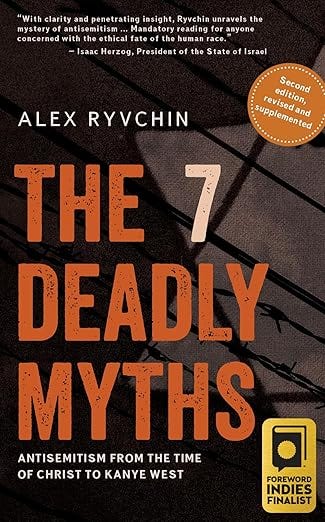
I’ve recently finished reading Alex Ryvchin’s distressing yet riveting book “The Seven Deadly Myths: Antisemitism from the Time of Christ to Kanye West”. To provide context for what follows, in 2025 Jewish people are best depicted as “an ethno-religious group with a global population of around 15 million. The two largest Jewish communities are in Israel (nearly 7 million) and the United States (around 6 million), with substantial communities of Jews…residing in Britain, France, Argentina, Russia, Canada, Germany and Australia” (Ryvchin, p.40). Jewish people make up 0.2% of the global population. They number 117,000 people and are an estimated 0.46% of the population of Australia, whose total population was 27,614,411 in June 2025.
In contrast, the global Muslim population is 2.02 billion, making them 25-26% of the global population. The latest official figure available from the Australian Bureau of Statistics (ABS) in 2021 is 813,392 Muslims, representing about 3.2% of the total population. It was projected that by 2025, the Muslim community would reach a significant milestone of 1 million in Australia. This is a large number of people with potential voter influence.
Antisemitism has existed since Judaism was founded by Abraham around 2000–1800 BCE in Canaan, which is roughly modern Israel. A people and a society known as “Israel” can be found at the dawn of the Iron Age, more than 3,200 years ago. No doubt for the sake of brevity, Ryvchin begins his exploration of antisemitism at the time of Christ. His well-researched arguments helped me gain clarity on this shape-shifting mind-virus.
The word “antisemitism” was created by Wilhelm Marr in 1879, a German populist and agitator, to provide semi-scientific legitimacy to his anti-Jewish activities. “Marr founded the League of Antisemites. It is often and incorrectly spelled with a hyphen and capitalization of “semitism” (anti-Semitism), which falsely suggests a hatred of Semites or Semitism. No such people exist, though the word “Semitic” refers to a linguistic family which includes Arabic and Hebrew” (pp. 42-43). Rapper Kanye West and basketballer Kyrie Irving, by self-identifying as “Semites” found a way of denying being antisemitic despite making hateful remarks about Jews.
Ryvchin posits that “antisemitism is not easily understood because Jews are not easily understood.” (p.10) They are bound by ethnicity, genetic markers, by religion or no religion, and that “This in itself is a source of animosity. We tend to fear that which we cannot easily place” (ibid). For as long as Jews have existed as a people, they’ve been treated like a puzzle to be solved. Are Jews a race, a religion, a nation? Every attempt at identification falls short, because they try to explain something deeply irrational with logic. Antisemitism has features we don’t see in other forms of hatred, as set out below. But what makes it stand out most is how it consumes the person who holds it just as much as the person it targets—turning prejudice into an all-consuming obsession.
Antisemitism has caused civilizations to decay with irrationalism and has contaminated immature minds with conspiracy theories. Philosophers, historians and social scientists have searched deeply to understand this unreasonable hatred, especially when attempting to make sense of the Holocaust. Why so many otherwise ordinary people—from different countries, jobs, languages, religions, and social classes—were able to take part in murder, cruelty, and humiliation isn’t that they were uniquely evil. It’s the result of nearly two thousand years of conspiracy theories that tied Jews to every imaginable wrong in the world: money, war, disease, deceit, arrogance, bloodlust—even the killing of God. These ideas were, and are, absorbed almost from birth in Gaza, the West Bank and much of the Muslim world, and sadly within Western societies as well. They are passed along through vivid stories, fiery sermons, great literature, celebrated art, and carefully crafted propaganda that play on fear and human weakness. Over time, for those believing the stories, this stripped Jews of their humanity, turning them from people into vermin.
In his book, Ryvchin seeks to take antisemitism to its roots, to “investigate each myth and show where they come from, who created them, how they spread and what horrors have been inflicted in their name” (p.30). He says the question of why the Jews are hated “remains ultimately unresolved and possibly unresolvable...they simply are”(p.38). Rational explanations have been absent for thousands of years and psychology, history, religion and politics have been unable provide a single, broadly accepted interpretation. His book is less concerned with the “why” and more with “how” antisemitism is transmitted from generation to generation (p.38). If we are able to understand “how,” we can as individuals, communities and policy makers begin to take meaningful action today. The “how” is to be found in conspiracy theories, the body of mythology that has clung to the Jews for millennia.
Providing source after source to validate his arguments, below are the seven deadly myths identified by Ryvchin that give rise to antisemitism, the persistent, irrational hatred of Jews.
Myth 1 – The Blood Libel
“A common feature of blood libel cases is the role of a single initiator, invariably a man of high office…often driven by motives such as financial indebtedness, who manipulates the passions of the many to satisfy some visceral desire to see the Jews humiliated, defeated and removed” (p. 50). This is what drove the many pogroms which have been committed against the Jewish people over centuries. Ryvchin quotes Alan Dundes who said “The blood libel may have been one of the most bizarre and dangerous legends ever created by the human imagination.” The Nazis wielded the power of this myth by publishing a book in 1943 called “Jewish Ritual Murder” detailing blood libel accusations throughout history.
The blood libel has been so resistant to logic because it works like a chilling warning story—a kind of horror tale meant to teach people to fear outsiders and distrust anyone whose beliefs or rituals feel unfamiliar. It also taps into something very primal: our instinct to protect children and to seek revenge when we believe they’ve been harmed. This is the most tenacious of all antisemitic myths.
This revengeful myth drives the international “Free Palestine” movement’s accusation that Israel is committing genocide in Gaza. Israel is not committing genocide in Gaza. As determined by a comprehensive new study by the Begin-Sadat Center for Strategic Studies (BESA Center) published in September 2025, genocide accusations are unsupported.
Palestinian civilian suffering in Gaza is not incidental to Hamas’s strategy, it is instrumental and weaponised. The underlying Islamist message is clear “You may not like us but look at the murderous Israeli alternative”. As shown in the two links above, the genocide blood libel has been effectively debunked. Yet it continues to be the lead accusation behind the distorted “facts” publicised by the humanitarian aid groups whose duplicity has now been exposed. Recognisable names behind this fabricated humanitarian crisis include UNWRA, multiple branches of MSF (Doctors Without Borders), World Vision, American Friends Service Committee (AFSC), Oxfam, Danish & Norwegian Refugee Council, CARE International, Caritas Internationalis (a global Catholic charity network), and the International Rescue Committee.
Myth 2 – Christ Killers
“The Christ-killers libel holds the Jews both collectively and perpetually guilty for the death of Jesus. It is the supreme charge. Deicide, literally the killing of a god, enabled a permanent severing of Christianity from the Jewish faith from which it stemmed and established the Jews as the supreme villains in the arc of Christian history, a satanic presence in the realm of the Lord” (p. 57).
Jesus was a Jew who lived in the Jewish homeland of Judea (part of today’s West Bank, together with Samaria), which was under Roman occupation for 400 years from 65 BCE. His followers, and the entire Christian population at that time, were Jewish. He was seeking to reform Jewish society and his followers abandoned Jewish tradition. Claims that Jesus was a Messiah posed a threat to established Jewish power structures as well as to Roman rule who saw their emperor as divine. Under Pontius Pilate, the Roman governor, Jews were routinely condemned to public execution by crucifixion.
In John and Matthew, two of the four Gospels of the new Christian faith, there was a firm accusation of Jews as the killers of Christ. From there “arose a distinct narrative, one which established the divinity of Jesus, the innocence of Rome and the eternal guilt of the Jews (p.58).
Even though in 1965 the Pope Paul VI officially proclaimed in “Nostra Aetate” the innocence of the Jews as killers of Christ, Ryvchin says this myth “powered by Gospel and soaked in two millennia of art, culture and tradition is difficult to fully dispel” (p. 66).
Myth 3 – Global Domination
The myth of Jewish global domination was created and maintained by men with a romantic yearning for an idealised, bygone Christian era.
Martin Luther wrote “On the Jews and Their Lies” in 1543 and Russian and German literature produced a steady sequence of antisemitic polemicists. In 1868 a German novelist Goedsche wrote a fictional chapter “The Jewish Cemetery in Prague and The Council of Representatives of the Twelve Tribes of Israel” claiming a plot by Jews to take over all the institutions in the world. He expanded this into a book in 1881 called “The Rabbis’ Speech” which spread across Europe. In 1903 Pavel Krushevan took over Moldova’s paper, followed by a Russian newspaper and published false antisemitic accusations in the notorious forgery “Protocol of the Elders of Zion”. This consisted of twenty-four points, setting out how the Jews intend to take over the world, through plundering the world’s gold, controlling the press and bringing chaos through the spread of liberalism and socialism.
Nazism raised the Protocols to almost a sacred text as Hitler saw Jewish conspiracy everywhere. He used the Protocols as an excuse to annihilate a race that he believed was behind every misfortune that occurred. Henry Ford in America was seized by the same mania. He bought a newspaper publishing company and from May 1920, published ninety-one weekly editions of the paper containing attacks on the Jews. He was devoted to the myth of Jewish conspiracy and in 1922 published a book “The International Jew” which had a broad global reach due to his wealth. It came into Hitler’s hands.
The global domination myth played a large role in the spread of violent antisemitism and provided the justification for genocide. When the Nazis invaded the Soviet Union in June 1941, Hitler deployed the Einsatzgruppen, the elite killing squads that were responsible for killing 1.5 million Jews, mainly by shooting them in cold blood.
Even though The Encyclopaedia Brittanica provides the authoritative background that the Protocols are a fraudulent antisemitic forgery, the myth of Jewish global domination is alive and continues to be weaponised today. Their Plan Is the Protocols of the Elders of Zion is a book chapter in Perry & Negrin (eds, 2008). It describes how Hamas’s founding covenant employed themes from the Protocols, reflecting an ideological adoption of the text’s conspiratorial ideas. In The Protocols of the Elders of Zion: An Authentic Document in Palestinian Authority Ideology, Marcus and Crook (2011) capture a public conversation that looks almost like a mirror image of Nazi Germany, where conspiracy thinking dominates much of the Arab world. They say that since the outbreak of the “Al Aqsa Intifada” in late 2000, the belief in the Protocols has joined up with apocalyptic Muslim beliefs to produce genocidal urges unrivalled since the Nazis.
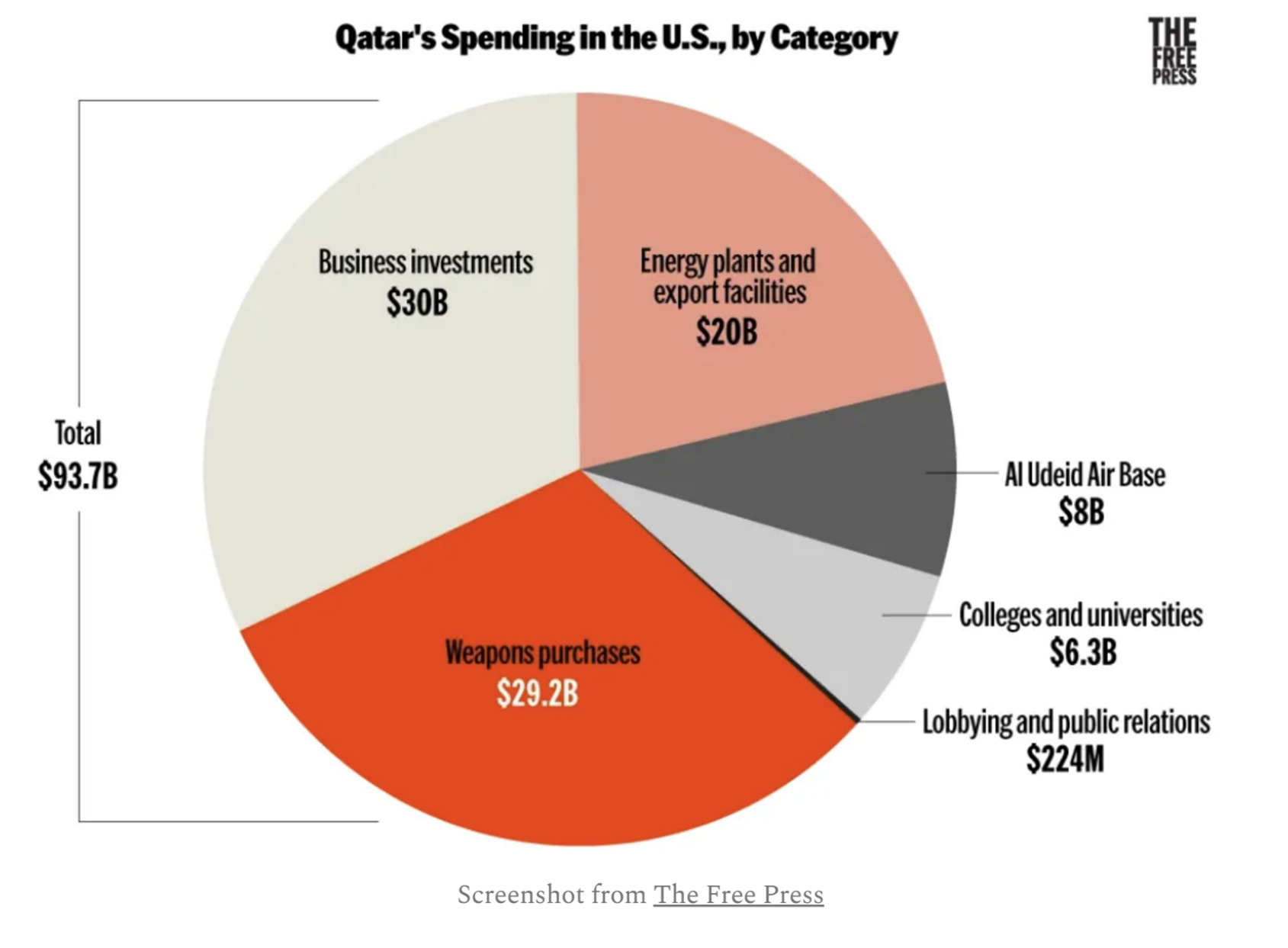
In 2025 the global domination myth drove the dominant narrative that Israel owns Washington. Eitan Fischberger’s research, The Numbers Don’t Lie: Qatar, Not Israel is Taking Control of D.C., demonstrates, with extensive data, that Qatar’s lobbying spending in the U.S. far exceeds Israel’s. His findings show that Qatar has invested billions into top U.S. universities; that Al Jazeera, which is substantially funded by Qatar, holds 136 congressional press passes, compared to 82 for The New York Times; and Qatar has purchased substantial real estate in Washington, D.C. knowing that proximity brings influence. He states “Any honest conversation about foreign influence in Washington has to start with the country that’s been pouring billions into U.S. politics, universities, media, and even the capital city itself. That country is Qatar.”
Myth 4 – Chosen
The conviction that the Jews as a whole think they’re superior to others runs through the extensive history of antisemitism. It supports and strengthens the other myths. The persecution of Jews is validated by the idea that this arrogant people must be taught a lesson by being humbled and humiliated.
This myth comes from the biblical concept that the Jews are God’s “Chosen People.” Being “chosen” in biblical tradition “…is a complex theological idea that carries with it covenants, reciprocal obligations, and the heavy burden to live righteously or face destruction” (p.98). Being chosen was a call to fulfill a purpose. That purpose involved a mission to serve as the first monotheistic faith, and demonstrating that belief in a single, benevolent god instead of worshiping idols, would usher in a system of ethical living. These ethics hold human life as sacred and showed a way of living that was measured and rational, focusing on one’s place within wider society, the arc of humanity and enacted by following a series of ethical precepts.
It involved the hard discipline of self-purification. This was not a commandment to impose their belief on others, as Judaism is a non-proselytising religion. Yet in order for the new faiths of Christianity and Islam to have validity, Judaism had to be rejected. The chosen myth is continually distorted to incite the hatred of antisemitism.
Israel Fact Check in Jewish Supremacy Claims: Debunking Anti-Semitic Myths, gives a detailed analysis explaining that the “chosen people” idea in Judaism refers to a covenant of responsibility, not ethnic or religious supremacy, and that reading it as evidence of Jewish superiority is a fundamental misinterpretation often weaponised in antisemitic rhetoric.
Michael Oren gives a scholarly discussion on “chosenness“ and its misapplication in socio-political arguments. He describes especially how theological concepts have been misused to justify claims about Israel, Jewish identity, and nationalism that can bleed into prejudicial or supremacist rhetoric. He says ”Can a country founded largely on secular and universalist principles lay claim to a uniqueness grounded in spiritual, particularist ideals?...The singling out of Israel by the United Nations and other international bodies, the media’s malign obsession with the Jewish state, and the transformation of elite universities into hotbeds of anti-Zionism — all suggest that Israel is, in some obverse way, special. Israel’s detractors today see it much as the medieval church regarded Jews, as chosen not for admiration but for contempt.”
Myth 5 – Money
The insult which has been hurled at many individual and collective Jews, is the accusation of mishandling money, either by being stingy or because they’re rich.
The New Testament has a story where Jesus enters the temple, drives out the people buying and selling there, and flips the tables of the moneychangers. Over time, that scene became central to early Christian portrayals of Jews as corrupting something sacred. Alongside it, the figure of Judas, who betrays Jesus for thirty pieces of silver, helped cement a link between Jews and money, tying financial greed to the much darker accusation of Jewish responsibility for Jesus’s death.
Ryvchin says “the term “Jew” has undergone a sort of mitosis, a splitting off, whereby it is at once a noun meaning a Jewish person, a verb meaning to swindle or haggle, and an adjective describing a shady handler of money… (It) has fed into some of the most virulent and deadly antisemitic myths—the Jew as controller of global finance, the Jew as cunning and untrustworthy, the Jew as motivated by the evil inclination to accumulate money, and the Jew as the obstacle to a better, less materialistic, more spiritual world” (p112).
As a result of centuries of discrimination against Jews, Europe in the Middle Ages associated Jews with the evil pursuit of money. In historical fact, various popes banned Jews from owning land, working as merchants or in trades, as well as barred them from receiving academic degrees or holding public office. As most means of survival were blocked to them, Jews were forced to lend money for interest. This was known as “usury” which, Pope Alexander III in 1139 proposed was punishable by excommunication. The money-lending profession was positive in that it was portable to other towns and countries, but it would also, according to Ryvchin “be disastrous for the Jews, placing a people considered inferior in the position of creditor, and leaving them open to despicable acts of treachery and exploitation” (p.115).
More recently, the Jew was the arch-capitalist, who blocked the solidarity of labor, according to Karl Marx. Today, the supposed connection between Jews, money and greed remains one of the most common antisemitic stereotypes in popular culture. Bolton, Chapelan & Vincent (2024) argue that modern antisemitism is frequently paired with a hostility to modernity and its economic expression: capitalism, free trade and the world of finance. Anti-capitalist discourse is a powerful mechanism of othering and a key element in the metamorphosis of traditional anti-Judaism into modern antisemitism.
Myth 6 – Dual Loyalties
The famous Dreyfus affair of 1894 is symbolic of the unfair trial, conviction and court-martialing of a French Jewish officer on the false charge of high treason. It is also a leading example of the belief in intrinsic Jewish disloyalty. Ryvchin asserts that “the suspicion that Jews are foremost loyal to the state of Israel above the countries in which they have lived, often for generations, is not the product of wartime paranoia or a slack racism rearing in turbulent times (p.137).”
Accusations of dual loyalties prompted antisemitic purges in the final years of Stalin’s reign in the Soviet Union. He targeted Jewish political rivals, instilled quotas on Jews attending university and emptied the foreign service of Jews. In post-war times, after the German Einsatzgruppen murdered 1.5 million Soviet Jews, Stalin loosened a flood of anti-Jewish repression to prevent what he feared was a disloyal uprising by the remaining Soviet Jews. He closed every Jewish cultural institution, murdered Jewish artists as traitors and spies in 1952, and tortured Jewish doctors on the charge that they were disloyal “murderers in white aprons”.
Hitler had a list of complaints against Jews, among which was the accusation of German Jews’ disloyalty to the state which caused them to sabotage Germany’s campaign in WWI. Richard Nixon accused Jews of being spies and that they should put America first instead of being Jewish. In Jimmy Carter’s administration, there was an unspoken “rule” that Jews could not work on the Middle East issue because they would be biased.
In 2019 American Congresswoman Ilhan Omar was accused by her own party of using antisemitic tropes accusing Jews of disloyalty. “Jewish advocates and communal representative bodies that are supportive of Israel are routinely dismissed as being “lobbyists”…whereas campaigners for the Palestinian cause are rarely characterized as lobbyists” (Ryvchin, p.145).
Obeying the laws of the land, committing to being good citizens and civil participation are Jewish traditions dating back to the original exile of the Jews from Israel in 722 BCE. On their return to Israel, the prophet Jeremiah (627-586 BCE) commanded the Jews to integrate fully into the country and to see themselves as belonging to that society.
Accusing Jews of “dual loyalty” has long been a clever tactic used by antisemites. Sometimes it’s said overtly, but more often it’s covert. Either way, it paints Jews as perpetual outsiders, people who are always suspect. This kind of thinking can quietly block career opportunities and is often used to question or limit their right to speak openly and advocate for causes that matter to them. One example cited in The Australian Jewish News (24 Apr 2025) reported on an Australia/Israel & Jewish Affairs Council (AIJAC) election questionnaire put to major political parties (foreign policy, Gaza, antisemitism, ABC/SBS complaints). This is an example of normalised lobbying/issue-advocacy, where supporters frame it as civic participation and transparency and critics frame it as organised influence-seeking.
Myth 7 – Oppressed to Oppressors
The words “Free Gaza and Palestine” were graffitied on a wall of the Warsaw Ghetto in May 2010. This slur was a desecration of a mass gravesite and international symbol of the Holocaust. In a more sinister way, it symbolised an act of replacement. The activists chose a site where Jews had been dehumanised and murdered, to declare that the suffering of the Jews in that location has been transposed to the Palestinians. This clearly accused the oppressed of becoming the oppressors.
Ryvchin gives several explanations for the erasure of Jewish suffering. First, the state of Israel was founded as a place of refuge from discrimination. If that history of persecution and suffering is “cancelled” or “erased,” the case for a Jewish state is severely undermined. Second, polling data on attitudes to the Holocaust show that 40% of Germans believe that “Jews talk too much about the Holocaust”. Replacing or erasing Jewish suffering effectively avoids confronting both historical and contemporary antisemitism and offloads any guilt felt as a perpetrator or bystander onto their ancestor. Third, the explicit equating of Zionism with Nazism is a pernicious form of revisionism, a dangerous rewriting of history.
“These audacious sleights of hand serve distinct functions in the spread of antisemitism. Firstly, they justify any act against the Jews as defensive measures. Secondly, they serve to arouse ever more hatred of the Jews for the double crime of falsely claiming persecution and persecuting others. Thirdly, they cleanse the consciences of the perpetrators, enabling them to commit unspeakable acts while maintaining a sense of morality” (p155). This is described by Ryvchin as a primary function of antisemitic thinking in the first place.
Israel’s most pointed critics accuse Israel of practicing genocide, ethnic cleansing, apartheid and many other severe crimes. They expertly brandish the “oppressed to oppressors” narrative, inverting reality and replacing it with narratives which manipulate emotionally laden primal instincts to protect the weak.
A 2021 White Paper Critical Social Justice Ideology and Antisemitism argues that “If not a deliberate feature, antisemitism is a reliable consequence of Critical Social Justice (CSJ) ideology…(and) the rapid proliferation of this ideology portends an increase in antisemitism.” The paper summarizes the various ways CSJ ideology fuels antisemitism and proposes a set of strategies to counter it. A 2024 article by Philip Carl Salzman posits that Social justice ideologies are to blame for the antisemitism of young people. Most universities throughout North America impose the woke gospel of social justice and postcolonial theory on the young minds for which they are responsible. A correlate of this is that fifty-three percent of the 18-to 24-year-olds surveyed in a Harvard Caps Harris Poll say students should be free to call for the genocide of Jews, and 67 percent of those say that Jews are oppressors and should be treated as oppressors – such as by calling for their genocide.
In his book, Ryvchin focuses on the mechanics of the transmission of antisemitism, in the hope that by naming them, we may be able to more directly confront and diffuse them as they arise. By vividly describing age-old antisemitic stereotypes, he shows how, despite their irrationality, these myths are a living threat to the Jewish people of today. Even though it changes throughout history by adapting to its environment, antisemitism remains virulent today. Ryvchin’s book is an invaluable source of information for anyone who is grappling with the perilous escalation and propagation of how conspiracy theories, neo-Marxist Critical Social Justice theories and irrational superstitions are driving today’s antisemitism.
Thnks Natalie. I hope you enjoy his book as it's well worth absorbing. Alex is an inspiring advocate for sanity, precision & clarity in these highly emotional times.
The book is my next read. Thank you for your eloquence and clarity.